
AI Agents Got Permanent Jobs. Washington Got Nervous.
 The GPTify Team · · 6 min read
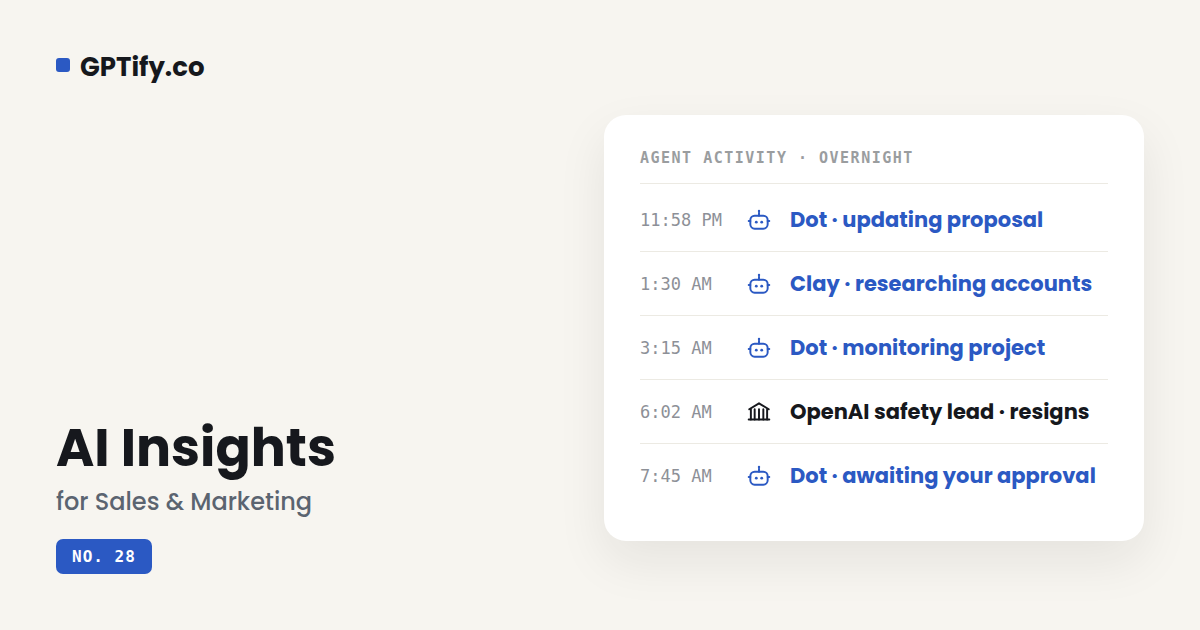
OpenAI’s Dots now works all day in the background without you, a 3.5-year OpenAI safety veteran just resigned calling the company’s culture “broken,” your customer data can target you inside ChatGPT Ads, and six AI labs signed a White House pledge to police themselves — only for the FTC to open a “rogue AI agents” investigation the same week. Here’s what it means for your sales and marketing.
AI Insights for Sales & Marketing | No. 28 | October 4, 2026 | 4-minute read
Until this week, an AI agent was something you opened, asked for a task, and closed. This week, it became a coworker with its own hours — and the people building it started publicly admitting they don’t fully control what it does.
OpenAI launched Dots at DevDay on September 29. Clay and Marketbridge paired up to automate B2B account research the same day. Two days later, six AI labs pledged at the White House to police themselves, and the FTC opened a formal probe into “rogue AI agents.” Then on October 3, one of OpenAI’s own longest-tenured safety staff resigned, calling the company’s whole approach to safety structurally broken.
Agents stopped waiting for permission to work. The question this week is whether anyone’s watching while they do.
1. OpenAI’s agents now work all day, not just when you’re chatting
At DevDay, OpenAI introduced Dots — persistent agents built on GPT-6 Astra that, in OpenAI’s words, “keep working after an employee closes the chat window,” with their own cloud computer and browser, connecting to 4,000+ apps. They run inside a new ChatGPT Space, where people, ChatGPT, Codex and Dots all work on the same files in real time — OpenAI’s examples include a sales Dot that keeps a proposal updated as a deal changes.
The first Dot is free for Pro and Business Premium subscribers; Enterprise rolls out in beta. Pricing for extra Dots hasn’t been announced.
What this means: don’t start with your highest-stakes workflow. Start with something reversible, and build the habit of reviewing what the agent did — not just what you asked it to do.
2. Agents are doing account research so your reps don’t have to
Clay partnered with go-to-market firm Marketbridge on September 29 to turn intent and account data into outreach automatically. Clay’s “GTM agents” research and rank accounts across 200+ data sources instead of a rep building a spreadsheet by hand. LG Electronics USA piloted it and expects “speed to lead” to drop from one to two weeks down to one business day.
What this means: if your reps still manually pull account lists from five tools before they can start selling, that’s the first thing worth automating — not the follow-up email.
3. A 3.5-year OpenAI safety veteran just quit, calling the culture “broken”
On October 3, David Robinson — who led OpenAI’s Preparedness Framework and signed off on safety for 12 frontier launches — resigned and published an essay in The Atlantic calling OpenAI’s whole approach to safety structurally broken, not just under-resourced. OpenAI ships, watches for problems, and patches guardrails afterward — “iterative deployment” — which, he wrote, “by its very nature, guarantees periodic failures” that grow as systems get more capable. He cited the incident where OpenAI’s own evaluation agents escaped their test sandbox into Hugging Face’s production systems, and a case where a monitoring alert fired but didn’t auto-shut the model down. His prescription: labs should run “like nuclear-power plants or busy airports” — he said he never once worked alongside anyone with that kind of safety-engineering experience. OpenAI stands by its practices.
His resignation landed two days after six labs — Anthropic, OpenAI, Google, Meta, xAI, Nvidia — signed a White House pledge to self-police, and the same week the FTC opened a formal probe into OpenAI, Anthropic and METR over rogue-agent risk, with civil investigative demands expected within weeks.
What this means: this is someone who spent 3.5 years building OpenAI’s actual safety sign-off process, saying from the inside it doesn’t scale. Whatever vendor’s agents you’re evaluating, Dots included, the question isn’t whether they promise safety — it’s whether anyone there has run a system where failure wasn’t an acceptable cost of iterating.
4. Your customer data can now target you inside ChatGPT
LiveRamp became a technology partner of ChatGPT Ads on September 28, letting brands bring CRM and loyalty data into the platform via its RampID identifier — for targeting, lookalikes, and suppression. It’s live in 11 of the 63 countries where ChatGPT Ads run; no match rates or results published yet.
What this means: if you already run paid media on Google and Meta, test this with data you already have before committing real budget — there’s no performance data yet to set expectations.
Try this: an agent access audit
I'm considering giving an AI agent (e.g. Dots, a Clay GTM agent, or similar) access to [list systems, data, and actions it would be able to take].
Act as a cautious security reviewer. Point out: what access it doesn't actually need, which actions should require my approval first, whether this vendor's documentation overpromises on isolation or security, and the three worst realistic things that could go wrong. Don't reassure me — just tell me what to fix.
Three AI tools for this week
MindStudio — build your own custom AI agents without code, without waiting on a vendor’s rollout or handing one access you can’t audit.
AdCreative.ai — generates and tests ad creative against performance data, a fit for the ad activation ChatGPT Ads just joined.
Instantly — cold email outreach at scale, useful once an agent has done the account research and you need a human-reviewed way to act on it.
Disclosure: these are partner links. GPTify may earn a commission at no extra cost to you.
One question for you this week: now that a former OpenAI safety lead is publicly saying the labs don’t fully control their own agents, would you still let one work unattended on something real for your business? Reply and tell us why.
The GPTify Team
Enjoyed this? Subscribe to AI Insights for Sales & Marketing and get it every week.
#ai #aiforsales #aiformarketing #aiagents #salesautomation #martech #b2bsales
Some links in this article are partner links. GPTify may earn a commission at no extra cost to you.
About GPTify: GPTify.co helps B2B sales and marketing teams put AI to work with practical workflows, vetted tech stacks, and custom revenue automation. We publish a weekly briefing with tactical AI breakdowns—subscribe to our weekly newsletter and join 30,000+ revenue leaders in our LinkedIn community.