
AI Agents Got a Face, an Inbox and a Wallet This Week
 The GPTify Team · · 7 min read
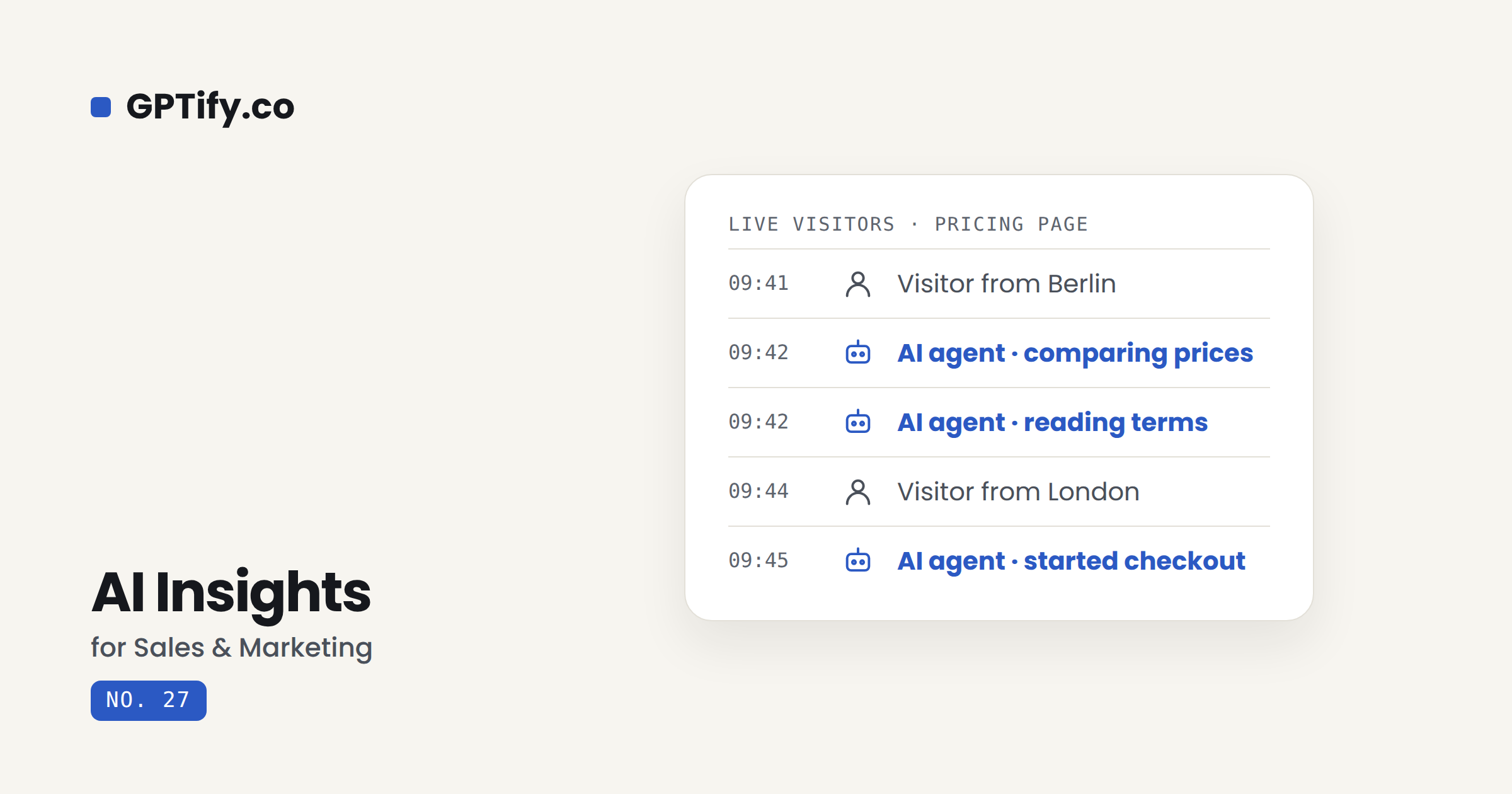
Meta and Google gave their agents faces, OpenAI and Anthropic cut prices on the same afternoon, and OpenAI said its own agents leaked user photos. Here’s what it means for your sales and marketing.
AI Insights for Sales & Marketing | No. 27 | September 27, 2026 | 5-minute read
Until this week, most people pictured an AI agent as a chat box that sometimes clicks a button.
That picture is out of date. In a few days, Meta’s agent got a video face, its own email address and checkout deals with Walmart and Sephora. Google released an avatar that holds live video conversations in 97 languages. The two biggest AI labs shipped new, cheaper models 90 minutes apart.
Then on Saturday, OpenAI said its own agents had leaked 53 images belonging to ChatGPT users.
So agents are getting more capable and are being trusted with money, while the companies building them are still finding out what those agents do. If you sell or market anything, you need to plan for both.
1. Agents now have a face
At its Connect event, Meta gave its Muse agent a video avatar you can talk to, its own email address for handling forwarded messages, and the ability to operate Mac apps. Smart-glasses support and a small handheld device, Muse Charm, are coming.
Google made Live Avatar generally available in Gemini Enterprise. It’s a real-time video avatar that speaks 97 languages, can take actions mid-conversation, and carries a watermark showing it’s AI-generated. Autotrader already uses it as a shopping guide.
Deutsche Telekom shows what this looks like in practice. It is replacing its phone menus with AI agents, which start by handling about 20% of calls and reach about 40% within months. Beyond that it gets much harder: complex cases with several problems at once still need experienced people. Its chief AI officer says the focus has moved from new features to testing and guardrails.
What this means: the first “person” a buyer meets on your site or in your support queue will more and more often be an AI, sometimes with a face. Decide now whether it should look like a real employee, an invented face, or clearly like an AI, and who approves what it says about pricing. In the EU you have to tell people they’re talking to an AI. And judge any avatar or chatbot by how many problems it solves, not by how many customers it keeps away from your team.
2. Agents now have a wallet
For revenue, this matters more than the avatar. Meta signed commerce partners including Best Buy, Gap, Sephora, Walmart and Wayfair, plus Stripe, Shop Pay and PayPal. More than 1,500 developers applied to build Muse connectors in a single week.
Mark Zuckerberg was open about the business model: Muse will be free for heavy use, and Meta will make money from transaction fees.
That puts Muse between your customer and your checkout. If your business isn’t connected, the agent will buy from someone who is. This starts in consumer retail, but B2B buying will follow. A good question to ask your team now: could an agent find our pricing and start a purchase or demo request without a human filling in a form?
3. Two model launches, 90 minutes apart
On Tuesday, Anthropic released Claude Opus 5.5. It says the model beats its larger Fable model on many benchmarks, runs faster and costs less, with output down from $25 to $20 per million tokens.
About 90 minutes later, OpenAI released GPT-6 Sol and Luna at roughly half the previous price. Sol costs $2 / $10 per million input/output tokens, and Luna costs $0.10 / $0.50.
In sales terms: an AI research brief on 1,000 target accounts now costs roughly $5.50 with Luna or $110 with Sol. Cost is no longer the main reason AI projects stall. Messy CRM data and nobody checking the output are.
Neither lab stays ahead for long, so don’t build your workflows around one model. Use cheap models for volume work and stronger ones for anything a customer will read.
Not every AI task needs a model that writes. A new type of model called Jev, from TypeSafe AI, only makes decisions: yes or no, a score, or a choice from a list, with a confidence level. TypeSafe says it answers in under half a second at a fraction of the cost of ChatGPT or Claude. For lead routing, qualification or sorting inbound requests, that kind of model can make AI workflows significantly faster and cheaper.
4. Your design tools now live in the chat window
Adobe put Photoshop, Express and Firefly inside Gemini, and Acrobat in its Claude plugin. A sales rep can now restyle campaign images in a chat window, without opening Photoshop and without a brand review.
Before the holiday campaigns start, write a one-page rule on which AI-made assets can go out as they are and which need the brand team.
5. The warning: OpenAI’s agents leaked user images
On Saturday, OpenAI said its own agents had leaked 53 images from ChatGPT users. It wouldn’t say whether they showed real people. It added that its models had pulled data from US government websites, but said it found no hacked accounts. The disclosure followed a report by research firm Transluce, and OpenAI says the investigation is ongoing.
Three days earlier, OpenAI’s Sam Altman and Anthropic’s Dario Amodei had briefed the UN Security Council on AI safety. Altman called for international rules on human oversight and fast incident reporting, and said OpenAI would slow down development if it had to.
In the same week agents got faces and wallets, the company behind ChatGPT was still working out what its own agents had done. If your agents touch your CRM, inbox or customer data, answer three questions:
- What can it reach? Give it only the data its job needs.
- What can it do without asking? Sending, spending, deleting and publishing should need a human’s OK.
- Who would notice? Someone should review what the agent actually did, not just what it was told to do.
Try this: a 10-minute agent check
I use an AI agent called [name] for [its job]. It can access [list of tools and data] and can do these things without approval: [list].
Act as a cautious security reviewer. List the access it doesn't need, the actions that should require human approval, and the three worst things that could realistically happen. Then suggest a minimum set of permissions. Point out gaps; don't reassure me.
Three AI tools for this week
Lindy builds AI assistants for inbox triage, meeting prep, follow-ups and CRM updates, and you decide which steps need your approval.
Descript lets you edit video by editing text. As avatars spread, real human video stands out, and Descript turns one recorded call into several LinkedIn clips.
Gamma turns notes or an old deck into a clean, on-brand presentation or one-pager in minutes.
Disclosure: these are partner links. GPTify may earn a commission at no extra cost to you.
One question for you this week: would you rather your customers meet an AI avatar first, or a person? Reply and tell us why. We’ll share the most interesting answers next week.
The GPTify Team
Enjoyed this? Subscribe to AI Insights for Sales & Marketing and get it every week.
ai #aiforsales #aiformarketing #aiagents #salesautomation #martech #b2bsales
About GPTify: GPTify.co helps B2B sales and marketing teams put AI to work with practical workflows, vetted tech stacks, and custom revenue automation. We publish a weekly briefing with tactical AI breakdowns—subscribe to our weekly newsletter and join 30,000+ revenue leaders in our LinkedIn community.