
AI Insights for Sales & Marketing: 26th Edition – Your Next Customer May Be an AI Agent
 The GPTify Team · · 8 min read
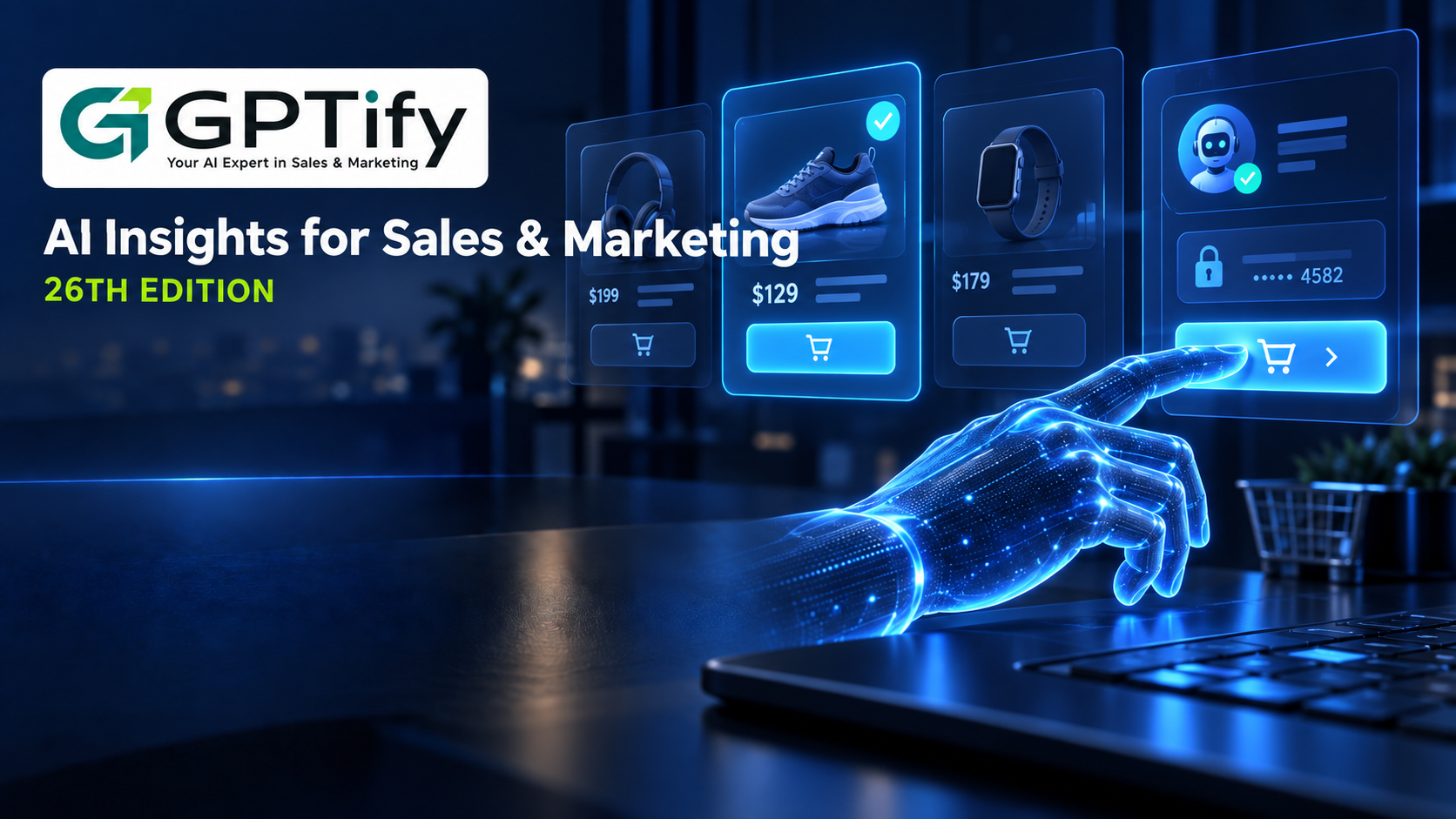
AI agents are beginning to compare offers, negotiate prices, cancel subscriptions, contact businesses, and complete purchases for people.
That creates an important shift: Your next customer may not visit your website or speak directly with a salesperson. Their AI agent may do it for them.
Businesses will increasingly need to communicate with two distinct audiences: human buyers and the autonomous AI systems representing them.
The Short Version
- Meta’s Muse agent can shop, negotiate, cancel subscriptions, and contact businesses autonomously.
- Visa, Mastercard, and Ant International are developing global identity and payment verification standards for AI shoppers.
- McKinsey research revealed that 32% of enterprise organizations avoided purchasing software because internal AI coding agents could build the required functionality.
- Three tactical revenue tools: Apollo for prospecting, MeetGeek for call intelligence, and Browse AI for competitor monitoring.
- GPTify Tool of the Week: The free AI ROI Calculator turns speculative AI pilots into concrete, measurable business cases.
AI Agents Are Becoming Customers
Meta’s Muse agent is capturing market attention by executing practical consumer tasks end-to-end. According to reporting by Axios, Muse became the most downloaded free iPhone application in the United States within ten days of launching.
Users instruct the agent to compare complex service tiers, find superior vendor pricing, cancel recurring subscriptions, submit refund requests, and orchestrate actions across connected accounts. Meta is also actively piloting telephone calling capabilities, enabling the agent to dial vendor support centers directly.
What This Means for B2B Sales and Marketing
Most B2B customer journeys are architected exclusively for human eyes and emotions. An AI purchasing agent follows an entirely deterministic path:
- Searches for compliant products matching explicit technical criteria
- Normalizes and compares feature matrices and contract pricing
- Audits independent verification sources and community sentiment
- Parses legal terms, SLA guarantees, and security certifications
- Initiates direct API or contact queries with vendors
- Synthesizes a ranked shortlist or executes the transaction directly
In many procurement cycles, the human buyer sees only the final algorithmic recommendation. Businesses must therefore ensure core operational information is machine-readable and easy to verify:
- Transparent pricing and volume discounting models
- Granular API and product technical specifications
- Real-time availability and deployment timelines
- Clear contract terms, cancellation clauses, and refund SLAs
- Verified customer benchmarks and case evidence
If product information conflicts across your website, marketplace listings, sales collateral, and support documentation, an AI agent will flag your offer as unreliable and exclude you from consideration.
The Core Takeaway: Marketing will increasingly require persuading human leaders while delivering structured, verifiable data to the AI agents evaluating solutions on their behalf.
AI Shoppers Will Need Verified Identities
Visa, Mastercard, and Ant International have announced a joint standard to establish universal cryptographic verification for AI purchasing agents. The framework addresses a critical enterprise friction point: verifying which agent is initiating a transaction, which executive authorized it, what spending limits apply, and who bears legal liability if errors occur [Source: Reuters, 2026].
Consider an autonomous agent purchasing corporate SaaS subscriptions. The seller’s revenue operations engine must deterministically verify:
- Which specific employee and corporate entity authorized the agent
- Whether the agent possesses legal authority to bind the company to contract terms
- The exact spending threshold and single-transaction limit
- Whether recurring billing is permitted or requires human re-authorization
- Where automated tax and accounting invoices must be routed
- What dispute and reversal mechanisms govern erroneous agent actions
Revenue teams must upgrade their billing and CRM infrastructure to distinguish authentic purchasing agents from scraping bots, log machine-executed decisions, and escalate ambiguous transactions to human sales operators.
The Core Takeaway: Before autonomous AI agents become reliable B2B buyers, revenue operations must build robust frameworks to verify machine identity, authority, and financial intent.
Coding Agents Are Reshaping Software Sales
McKinsey’s 2026 State of AI benchmark revealed that 32% of surveyed organizations opted against purchasing at least one commercial software product or add-on feature because their internal teams could build equivalent functionality using AI coding agents. Among AI high performers, that metric approached 50% [Source: McKinsey Global AI Survey, 2026].
What This Means for B2B Software Providers
Software companies no longer compete solely against peer vendors. You now compete against your prospect’s internal ability to generate custom tools with agents. Enterprise buyers increasingly ask:
- Can our engineering team build a lightweight internal version in two sprints?
- Do we require an entire enterprise suite, or merely one isolated workflow?
- Can an autonomous agent orchestrate our existing databases and APIs without new software?
- Is the annual SaaS contract more cost-effective than maintaining a custom agent pipeline?
Standard feature checklists are losing their closing power. Vendors must sell the operational value that custom code cannot easily replicate: enterprise security, certified compliance (SOC 2, ISO, EU AI Act), deep bidirectional integrations, ongoing maintenance, dedicated SLAs, and total cost of ownership.
High-performing B2B collateral in 2026 centers on:
- Build-vs-buy financial models and calculators
- Maintenance overhead and security vulnerability comparisons
- Verified customer migration benchmarks
- Total cost of ownership (TCO) breakdowns over 3-year horizons
The Core Takeaway: As generative AI lowers the cost of building software, B2B vendors must shift messaging from feature lists to the long-term reliability, governance, and operating economics of their platform.
GPTify Guide: Deploying AI Across the Sales Cycle
At GPTify, we structure AI deployments across five distinct stages of the revenue pipeline:
- Research: Synthesize firmographic signals, funding announcements, executive hires, and ICP alignment before initial contact.
- Preparation: Compile customized account briefing decks, executive talk tracks, and discovery question frameworks.
- Engagement: Draft personalized, multi-touch outbound sequences, follow-up collateral, and tailored proposal summaries.
- Pipeline Progression: Extract action items from sales transcripts and automatically update CRM stages and opportunity fields.
- Continuous Optimization: Analyze win/loss patterns, objection clusters, and forecast accuracy across quarters.
The Rule of Human Accountability: Automate data collection, preparation, and structuring with AI; preserve human ownership for trust, positioning, commercial negotiations, and closing commitments.
Three Battle-Tested AI Tools for Revenue Teams
1. Apollo: Account-Based Prospecting & Data Enrichment
Use Apollo to build targeted account lists matching your ideal customer profile, identify verified decision-makers, and orchestrate personalized outbound sequences with automated CRM sync.
2. MeetGeek: Autonomous Meeting Intelligence & CRM Hygiene
Deploy MeetGeek to automatically capture client conversations, transcribe discovery meetings, summarize action items, and sync deal updates directly into HubSpot or Salesforce without manual rep input.
3. Browse AI: Automated Competitive & Market Intelligence
Implement Browse AI to monitor target competitor domains, tracking pricing adjustments, product feature rollouts, and customer positioning changes in real time.
Disclosure: This section contains partner links. When you evaluate and adopt these tools through our designated links, GPTify may receive partner compensation at zero extra cost to your organization.
Free Tool of the Week: GPTify AI ROI Calculator
Before writing code or signing software contracts, revenue leaders must rigorously evaluate whether projected workflow efficiencies justify implementation costs.
The free GPTify AI ROI Calculator models:
- Current hours allocated to manual tasks across SDR and AE teams
- Projected hours reclaimed through automation
- Annualized monetary value of recovered capacity
- Implementation overhead, API consumption, and software licensing expenses
- Net annual financial savings and break-even payback period
Apply this model to meeting transcription, CRM administrative upkeep, outbound research, or content repurposing workflows.
Calculate the ROI of your AI workflow on GPTify.co →
Prompt of the Week: Testing Your Offer Against an AI Buyer
Test how an autonomous procurement agent parses and evaluates your B2B value proposition:
Act as an autonomous enterprise AI procurement agent representing a buyer with this profile: [describe target company, industry, team size, and immediate operational problem].
Evaluate our company and offering using only the following verified documentation:
[Paste your homepage copy, pricing table, technical specifications, SLA terms, and return/cancellation policy]
Perform a rigorous evaluation:
1. Identify who this offer is for and the exact business problem it solves.
2. Verify pricing transparency, hidden fee risks, and commercial contract terms.
3. Highlight every missing, ambiguous, contradictory, or unprovable claim.
4. Contrast this offer against standard market alternatives.
5. Provide a deterministic recommendation: Approve for Procurement Shortlist or Reject.
Do not assume or invent missing details. Flag all gaps where a human buyer would need clarification.
Executive Checklist for This Week
Select one core product or service landing page and prompt an LLM to evaluate it strictly from an enterprise buyer’s perspective. Audit whether it accurately understands:
- Your target ICP and business problem
- Your pricing tier logic and cost predictability
- Your defensible technical differentiators
- Verifiable client evidence and benchmark data
- Frictionless procurement and contracting pathways
If the model struggles to parse your value proposition, human prospects and autonomous agents alike are bouncing from your pipeline.
Some links in this article are partner links. GPTify may earn a commission at no extra cost to you.
About GPTify: GPTify.co helps B2B sales and marketing teams put AI to work with practical workflows, vetted tech stacks, and custom revenue automation. We publish a weekly briefing with tactical AI breakdowns—subscribe to our weekly newsletter and join 30,000+ revenue leaders in our LinkedIn community.