
The Death of Traditional MQLs: Why Revenue Teams Are Shifting to AI-Qualified Leads (AQL)
 The GPTify Team · · 4 min read
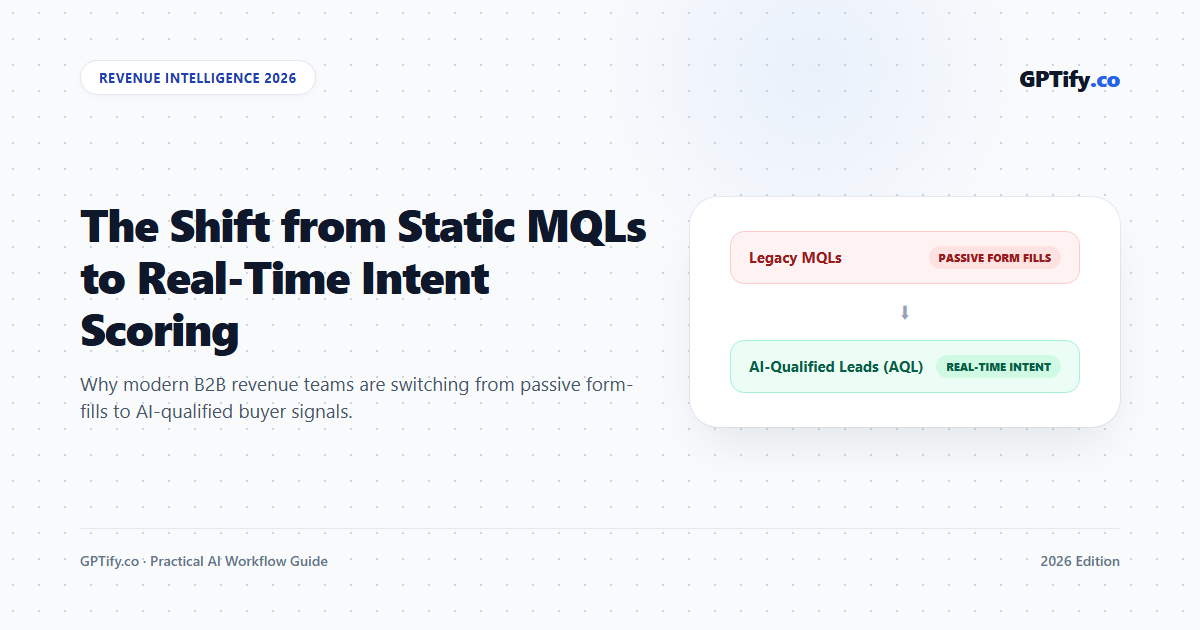
For over a decade, B2B demand generation relied on a predictable formula: gate an ebook behind a form, assign 10 points to a submission, add 5 points for a website visit, and notify an SDR when a lead crosses 50 points. That model is obsolete. Today, when auditing CRM pipelines for growth-stage B2B companies, we repeatedly find sales teams wasting hundreds of hours chasing low-intent PDF downloaders while high-fit buyers slip away unnoticed.
The traditional Marketing Qualified Lead (MQL) is broken. Modern B2B buyers do not fill out forms to access basic product overviews. Instead, over 70% of the purchasing journey occurs anonymously across peer networks, technical documentation, and community channels before a buyer ever requests a conversation. Relying on point-scored downloaders guarantees rep burnout and pipeline stagnation.
The Structural Flaw in Legacy Lead Scoring
Legacy MQL engines suffer from two core defects: superficial intent signals and zero context evaluation.
A university student downloading a research report receives the same score as a VP of Engineering reviewing your security documentation. Traditional scoring treats raw activity as buying intent, lacking the capability to evaluate organizational fit alongside subtle behavioral indicators.
Consider the standard SDR workflow: a rep receives an alert for a form submission, opens Salesforce or HubSpot, finds an unverified personal email, spends 15 minutes cross-referencing LinkedIn, and realizes the contact is an entry-level researcher with zero purchasing authority. Repeating this manual loop dozens of times a week cripples sales efficiency.
Enter the AI-Qualified Lead (AQL)
At GPTify, we help revenue teams replace static scorecards with multi-signal intent synthesis: the AI-Qualified Lead (AQL). Rather than counting button clicks, an AQL system continuously analyzes structured and unstructured signals to determine whether an account is actively inside a buying window.
An effective AQL architecture evaluates four telemetry vectors before alerting a sales rep:
- Firmographic & Technographic Fit: Real-time headcount growth, technology stack deployments, and executive hiring verified through waterfall enrichment platforms like Full Enrich or Apollo.
- First-Party High-Intent Behavior: Repeated visits to high-intent pages (API specifications, pricing tables, or security certifications) combined with session depth.
- Unstructured Inbound Telemetry: Sentiment and specific requirement analysis from incoming live chats, contact form inquiries, or demo request details.
- Buying Committee Coverage: Detection of multiple stakeholders from the same domain visiting your assets simultaneously, indicating an active organizational initiative.
“An MQL asks: ‘Did someone click a link?’ An AQL asks: ‘Does this company match our ICP, are they experiencing verified operational friction, and are multiple decision-makers actively evaluating solutions right now?’”
For practical blueprints on lead triage and revenue architecture, explore the playbooks library on GTM Shelf.
Building an AQL Pipeline: 3 Core Stages
1. Instant Data Verification and Enrichment
Every inbound inquiry is enriched immediately. Before any sales rep reviews the submission, the workflow verifies corporate domain ownership, employee count, and current tech stack.
2. LLM Contextual Evaluation
The enriched record is passed to an AI evaluation prompt that benchmarks the profile against closed-won account history. Instead of returning an arbitrary number, the engine produces a concise briefing: why this account qualifies, the primary use case, and recommended discovery questions for the rep.
3. Dynamic Lead Routing
If the lead meets verified AQL criteria, it is pushed directly to the sales pipeline in your CRM—such as Pipedrive or HubSpot—and triggers a Slack alert to the account executive. If the lead is qualified but not yet ready for a sales conversation, it routes automatically into a tailored educational sequence via Lemlist without consuming SDR time.
Key Performance Benchmarks: Measuring the Shift
When B2B revenue teams shift from traditional MQLs to AQLs, top-of-funnel volume typically drops by 40% to 50%. However, pipeline velocity and conversion efficiency improve dramatically:
- AQL-to-Opportunity Acceptance Rate: Over 85% of AI-qualified leads convert into active sales discovery calls.
- Speed to First Engagement: High-intent accounts receive tailored outreach within 5 minutes of signal detection.
- Rep Productivity: Sales reps spend their time holding high-conviction discovery calls rather than manually researching unqualified form submissions.
About GPTify: GPTify.co helps B2B sales and marketing teams put AI to work with practical workflows, vetted tech stacks, and custom revenue automation. We publish a weekly briefing with tactical AI breakdowns—subscribe to our weekly newsletter and join 30,000+ revenue leaders in our LinkedIn community.
—
*Some links in this article are partner links. GPTify may earn a commission at no extra cost to you.*
**About GPTify:** [GPTify.co](https://gptify.co) helps B2B sales and marketing teams put AI to work, with training, ready-to-use tools and custom AI workflows.