
Building Autonomous AI Revenue Workflows: A Step-by-Step Blueprint for B2B Teams
 The GPTify Team · · 4 min read
When auditing CRM pipelines for mid-market B2B companies, we repeatedly find the same operational bottleneck: sales representatives spend up to 34% of their working hours manually updating contact fields, copy-pasting meeting notes, and running repetitive prospect lookups. This administrative drag directly causes delayed lead response times, lost deal attribution, and high sales team turnover.
At GPTify, we work with B2B revenue teams across North America and Europe to replace these manual bottlenecks with autonomous revenue workflows. The objective is not to replace human judgment during enterprise sales cycles, but to automate every administrative step between lead discovery and the actual sales conversation.
Here is the practical, modular architecture we build for revenue leaders who want to scale pipeline velocity reliably. (If you are assembling your own tooling, you can benchmark vetted AI software by funnel stage on GTM Shelf.)
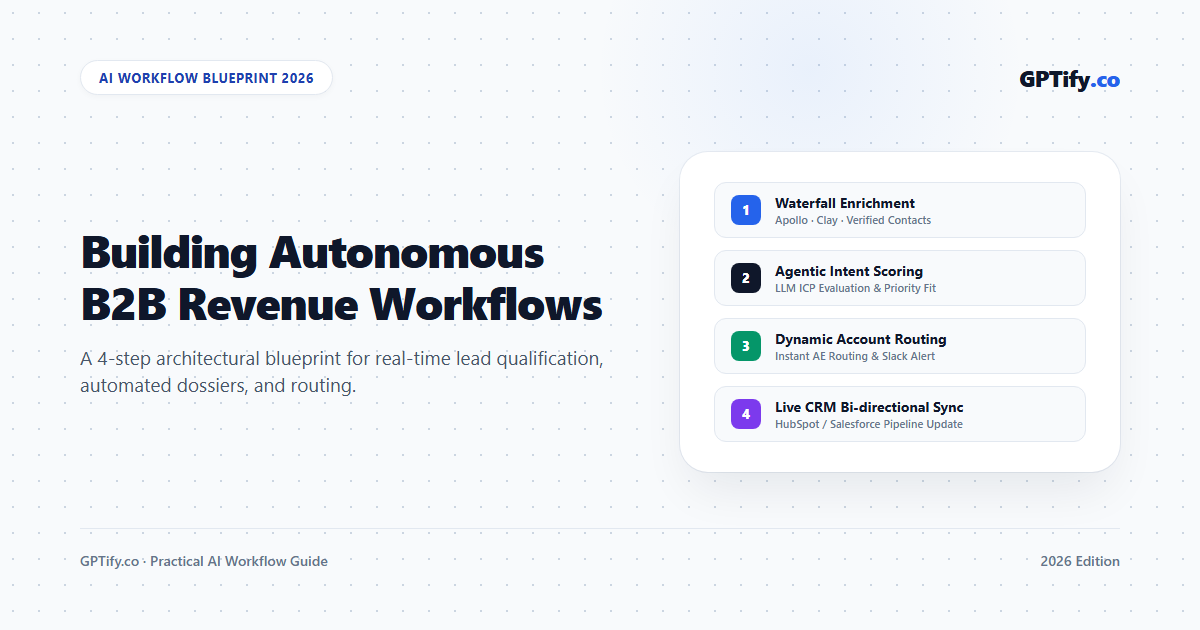
Layer 1: Multi-Source Waterfall Data Enrichment
Relying on a single data provider inevitably results in missing phone numbers, outdated job titles, and high email bounce rates. High-performing autonomous pipelines implement a waterfall enrichment logic: if Provider A lacks a verified corporate email or direct dial, the system immediately cascades the query to Provider B.
In our client architectures, raw leads from website forms or outbound target accounts are enriched through waterfall providers like Full Enrich or unified intelligence platforms like Apollo. The workflow verifies firmographic thresholds, headcount growth, and current software stacks before creating or updating the record in your CRM.
Operational Rule: Never allow unverified data to trigger automated outbound sequences. Hard validation checks—such as MX record pinging and disposable domain filters—must run before any email account initiates outreach.
Layer 2: Deterministic AI Lead Scoring and Triage
Traditional point-scoring models (such as adding 10 points for downloading a guide) fail to distinguish between casual readers and genuine buyers. An autonomous AI qualification agent evaluates qualitative parameters—such as open hiring listings, recent company press releases, and stated pain points—alongside numeric demographic data.
By running inbound submissions through an LLM evaluation node, your pipeline classifies accounts into three distinct tiers within 60 seconds of submission:
- Tier 1 (High Fit, Active Intent): Instantly notifies the assigned Account Executive in Slack and suggests a personalized discovery agenda.
- Tier 2 (Good Fit, Low Urgency): Enrolls the prospect into an automated, value-first educational sequence.
- Tier 3 (Mismatched Profile): Routes to a low-touch newsletter list without consuming SDR time.
Layer 3: Meeting Intelligence and Real-Time CRM Field Mapping
Sales reps rarely log exhaustive notes in the CRM after discovery calls. Crucial details regarding budget timelines, competitor shortlists, and decision-maker objections get trapped in raw recordings.
We integrate autonomous meeting intelligence to capture calls automatically. As soon as a demo concludes, a structured prompt parses the transcript, extracts BANT or MEDDPICC criteria, and syncs clean updates directly into your CRM—whether you run HubSpot, Salesforce, or Pipedrive.
- Extracted Pain Points: Synced directly into structured CRM fields.
- Competitors Mentioned: Mapped to multi-select deal properties.
- Agreed Next Steps: Automatically generated as assigned CRM tasks for the account owner.
Layer 4: High-Deliverability Outbound Activation
When automated qualification identifies net-new target accounts matching your ICP, outbound messaging must adhere to strict deliverability standards. Blasting high volumes from primary email domains ruins corporate domain reputation rapidly.
Route qualified accounts into dedicated outbound engines such as Lemlist or Instantly. To protect inbox placement across high-volume campaigns, pair your sending software with deliverability testing tools like InboxAlly to monitor seed inbox placement and inbox health before increasing daily volume.
Three Core Guardrails for Production Systems
Autonomous revenue systems fail when built without operational guardrails. When engineering these pipelines for GPTify clients, we enforce three architectural rules:
1. Automatic Retry and Error Catching: Third-party APIs occasionally experience rate limits. Ensure your automation tool buffers records and retries failed calls instead of dropping leads silently.
2. Human Approval for Enterprise Deals: For enterprise accounts with estimated ARR above $50k, enforce a human-in-the-loop step. Have the system draft the personalized message and alert the AE in Slack for one-click approval before sending.
3. Strict JSON Schemas for LLM Prompts: Never use freeform text prompts for CRM updates. Enforce strict JSON output schemas with predefined field values to prevent model drift from polluting your CRM reporting.
About GPTify: GPTify.co helps B2B sales and marketing teams put AI to work with practical workflows, vetted tech stacks, and custom revenue automation. We publish a weekly briefing with tactical AI breakdowns—subscribe to our weekly newsletter and join 30,000+ revenue leaders in our LinkedIn community.
—
*Some links in this article are partner links. GPTify may earn a commission at no extra cost to you.*
**About GPTify:** [GPTify.co](https://gptify.co) helps B2B sales and marketing teams put AI to work, with training, ready-to-use tools and custom AI workflows.